I'm more than a little thrilled to finally share the news that my prompt books for writers are at long last up on Amazon. You can find info about them here... http://www.charlottedillon.com/MyWriting.html
Make Cures Happen! Please help fight cancer by giving to The Leukemia & Lymphoma Society! My husband is running a marathon -- that's 26.2 miles -- in support of the Leukemia & Lymphoma Society.
Help him help them by donating money to the cause. You can give as little as five dollars, and it goes right to LLS. Visit the page they set up for my husband here, and click on the link there to get to the donation page. If a lot of people give even just a little, together we can make big things happen. Please share the link with friends and family.
I get questions almost daily from people who visit my site. A lot of those questions come from other writers, and many are in some way about building characters and then keeping up with all of the information about each. Let's face it, well-built fleshed-out characters take a lot of work and thought. It's easy to come up with those cardboard cutouts, those true to form characters who are little more than a layer thick and always react in a stereotypical way. Easy is seldom the best way.
Here are some tips I've learned over the years to help you build your own memorable characters and then keep up with who has blue eyes and who hates cats. (I've added links to some books, sites, and programs throughout this article to give you extra help.)
When I get ready to write a new story, I like to start with some basic information about a character. Stuff that pops into my mind usually with a scene that he or she is staring in. That scene is enough to get me excited about the story. (In fact, I have a whole pile of them put aside. Word of warning. If those scenes or new ideas for stories pop into your mind when you are working on something else, probably at a point where you are having trouble with that old story, type up a few notes and file them away, then get back to work on your work in progress. Once it's done, you can pick a new one. If not, if you let the sparkle and shine of those new ones call you away, you'll end up with a pile of stories in various forms of completion, with few to none finished. Starting a story is the easy part. It's working through the whole thing and reaching the end that is the hard part. Even rewrites are easy compared to getting that rough draft out there and the end typed.)
Okay, let's see, where was I? Oh, I remember.
The new story that you are supposed to be starting. Back to that basic information. It's good to know some little things about your character right off. Who she or he is, where she is, how old she is, why she's doing or reacting the way she is. Then you need to know a lot more. A good way to do that is with a character chart. I have a free and very detailed one up on my site.
Now don't panic. I know there's a lot of questions and blanks there. Maybe more than you know or want to know about your character. That's okay. You don't have to fill it all out now. You don't even have to fill it all out later. You can copy and paste it into Word and then delete sections or give yourself more room. Fill in what you think is important and add more later if needed when you really get to know this new character. The chart will help you dig deeper into the character though, figure out what makes her tick and why and how she will act and react. It's just one tool to help you add layers to that character.
After I get a feel for my character, my next step is a name. I sometimes name them first, but once I know them, the name doesn't always seem to fit. To find names, I like to use The Writer's Digest Character Naming Sourcebook by award-winning romance author Sherrilyn Kenyon. It's a big book with lots of sections, all kinds of names, broken up by type and gender. As I glance through the pages it seems like one name will stand out and belong to the character. Almost as if the character says that's me, that's my name. There are some good sites on line you can use as well. Check out my page here. If you have baby naming books on hand, those are good too.
Even though by this point I have that name, an idea of what my character looks like, who he or she is, and even how she dresses, I often need a reminder. I'm working on a series right now, and there's no way I could keep it all straight in my head. Sometimes I can't even recall what I did ten minutes ago. Even if not working on a series, there are characters that have small parts, but that you would like to make stand out or be sure to get their look right. For this I use a game. A computer game. Yes, a real game. One my kids loved. I saw them playing it and thought wow, could I use that.
It's call SIMS. I use SIMS 3 now. If you have an older computer you might want to try SIMS 2. (Check the information on what your computer needs to have to run SIMS before you pick out one.) Some people like 3 better than 2 while others like 2 better. You can do most of the stuff with SIMS 2 that you can do with SIMS 3. Though 3 is much more fine tuned. I'm going to use SIMS 3 to explain things, since that's the one I have fresh in mind. With SIMS 3 you can build a character, give her or him a hair style and color that fits. Makeup and eye color, skin color, and even pick out body type and outfits. In the story I'm working on the hero's kid sister is kind of testing her freedom now that she's nineteen. She wears odd and sexy clothes and has an eye-catching hair style and makeup. Her hair is bright red with black tips and green highlights.
I was able to do that with her hair in SIMS 3 with ease. I was also able to pick out some odd outfits, give her a tattoo, and take some snapshots of her with yellow contacts in and black eye shadow and lipstick on, and other shots with her wearing black contacts and blue eye shadow and lipstick. You can take snapshots right there in the Build A Sim feature in 2 or 3 while building your character, and move those pictures to another program and keep up with them.
You can even build their homes and decorate each room and take pictures of that. Really helps you remember where the back door is in the hero's home, or what the heroine's bedroom looks like, even what color the blanket on her bed is. With 3 you can also pick out special things about your character, like a green thumb or loves to cook, or hates the outdoors, even good or evil, ect... If you don't want to use SIMS, you can simply find pictures of people on the internet and use them, or even tear pictures out of magazines, but I like to have all of my information on the computer. (Don't forget to do backups, often, and save in other places or ways. Computers don't live forever and things can go wrong. The same goes when it comes to saving your writing.)
Sooooo.... Once you have those charts filled out, those pictures, ect... How do you organize all of it?
My favorite way to keep up with notes and pictures about my work in progress, and even other works, is with Microsoft OneNote. I actually had this on my computer for awhile, but never used it. Then I kept hearing other writers talk about how helpful it was, so I gave it a try. It took me a few false starts to figure things out and get comfortable with it, but now I wouldn't want to try and put a story together without it. You can have OneNote open, and have tabs across the top for stuff like Characters, Outline, Plot Points, Setting, Extra Info, even the title of a few different stories, ect.. You can click on one of those, say Character, and add tabs down the side of it, one for each character. I do one tab for each main character, and then one titled Other for less important characters.
For each of those main characters, I have a lot of stuff on their page. Like Amber, the heroine in the story I'm working on now. On her page I have a few face shots from SIMS of her, and then a few full shots of her in different outfits, even different hair styles. I also have some pictures I did a copy and paste of from the internet of a 1974 Ford Mustang. Inside and out of it. Since that's her car and she's put a lot of work into it, so it's important to her and I know I'll have to describe stuff about it in the story. I also have her character chart, a bio, and other stuff on her page. It's all in that one neat spot.
If I need to get to info about the hero, a glance to the side and a click on his name tag, and I'm on his page. It's easy to copy and paste and move stuff to any page. It's also easy to add new pages, tabs, sections, ect... I just leave OneNote open while I have my Word program open writing, or even if I'm just doing research. Saves a lot of time and trouble. By the way, if you don't have Word or OneNote, you can buy them together with Microsoft Office Home and Student.
I hope this article and the links within it helps you get to know your characters better and keep up with that information in an easy way so you can write the best book you can.
It's a great idea. You get to maybe reach a new reader with your book, you can use the cost of the book or books, and probably even postage, as a tax write off, and you get to prevent lots of kittens from being brought into a world where they will they won't be cared for.
*******PLEASE FEEL FREE TO FORWARD THIS*******
A local animal shelter is having a book fund drive in May. They are selling new and used books on May 11th to raise money to spay and neuter feral cats. Any book donation you make will be acknowledged with a receipt that can be used as a tax deduction.
You can send books to:
Volunteers for Animal Welfare 15 Mastic Rd Sound Beach, NY 11789
Harlequine is giving away 16 of it's romance novels for free. You simply download, then read. The link is below. You can pick through and download the ones you want. You don't have to sign in, even give your name or e-mail address. No catch, just enjoy. Smile.
The Preditors & Editors Poll is up again, and this time I'm thinking to mention it before the voting time is over. :-) I'm rather proud of myself for that. hehehe
If you belong to or have taken part in my free RWC groups for writers and found it helpful also, it's up for voting too, under Writers' Discussion Forum.
It takes only a second to vote. You do have to give your name and e-mail address, and then click on a link they send in e-mail to get your vote counted, but that's to keep people from voting more than once for the same thing. Keeps things fair. :-) The site is on the up and up, and they won't do anything with your name or e-mail address, other than use it to count your vote.
Either way, thanks for taking the time to read my blog post either way. By the way, while at the P&E site, don't forget to vote for the other things there, like your favorite author site, novel, review site, ect....
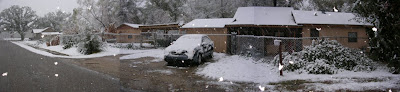
As many of my online friends know, I live in the South. Way south. Like Southeastern Louisiana, not too far from New Orleans and even closer to Mississippi. Well, believe it or not, those white covered objects in these pictures are mine. My house, my car, my fence, my cactus, my banana trees, my grass, ect... Didn't think to snap one of the orange tree which was still full of lovely oranges...
It was over seventy here a couple of days ago, and in a couple more days it will be back up there -- but today...
Well, let's go back to last night. It rained all night. This morning about five I had gone back to bed and was listening to the rain fall. My husband, who had made it to work, called to tell me it was sleeting and that there was some snow mixed in. I thought sure, a few flakes. Never even stick to the ground. A few minutes later I got another call. It was really snowing, so I was told. I grumbled and crawled out of bed, figuring I'd be lucky if in the glow of the porch light I could see even a few tiny flakes. I made my way to the back door and opened it to look out.
It was really snowing! It was really snowing real snow!
In a few minutes, it was really, really snowing. I ran and dragged my daughter out of bed with the news. By the time we made it back to the door, the flakes were huge, falling fast, and actually sticking to things. We rushed and dressed, and my son who is a married man now and lives next door, came over with his wife in tow just as I was slipping on my shoes. We all ran out into the dark, into the falling snow and watched in wonder and laughed like children.
By the time the sun came up, we found ourselves in a winter wonderland, like those we have seen on TV. We built a snowman, the kids threw huge snowballs back and forth at each other. We slipped and fell on the ice and laughed even more. We let the dogs out and they tip-toed around through this white unknown and then began to run and play too.
There was much fun had by all the two legged and four legged family members. Even hubby got sent home from work before noon. The schools were closed and when we tried to watch TV, all normal programming had been pushed aside so all of our local, which is New Orleans for us, news programs could broadcast about the snow that was falling. It continued to snow until noon. We got five inches of snow. Snow that stayed on the ground. It's night now, and there is still snow on the ground, though the patches of non-snow are getting bigger and bigger.
It's been an amazing day for us! Smile Hope something made yours just as nice. Most of us spend too little time smiling and acting like kids. Smile
If you are looking for a great gift for a writer, even if that writer if yourself, then I've got a couple in mind, and right now Amazon has them with lots off, up to 52% off.
First up is a laser printer. If you are like me, you've been wanting one forever, both for the speed it prints and the much cheaper price per page. They've always been way up in price, my idea of way up anyway, and the ink for them was also too high. I found a really great one though with ink that won't break you. It even comes with a starter toner cartridge that prints a 1000 pages. It's the Brother HL-2170w 23ppm Laser Printer with Wireless & Wired Network Interfaces. It prints high-quality 2400 x 600 dpi resolution and has a 250-sheet capacity tray.
When you order it, go ahead and oder the Brother TN360 High Yield Black Toner Cartridge to go with it. It prints 2,600 pages. That means between it and the starter one you get with the printer, you are good to print 3,600 MS pages. Pretty good deal!
If you aren't in need of a good printer, check out Microsoft Office Home and Student 2007. It includes the 2007 versions of Word, Excel, PowerPoint, and One Note. I perfer to use Word, since you'll find that it's the standard most editors and agents, even in articles and such, request you use when they want a copy of CD or e-mailed to them. It's at a great price right now. I personaly don't use Excel or PowerPoint, but I have a daughter in college, and she often has work she has to do in one or the other, so with this program I covered myself and her. If you look at the price of Word alone, or Excel or PowerPoint, you will see what a great deal this is. Hey, as writers, we have to save every cent we can. Smile.
I have a number of writing friends who are busy doing NaNo. The month is halfway over and I've found a lot of them running out of steam. If you took the challenge to write a novel in a month, don't give up during these last couple of weeks. Even if you don't reach your goal, maybe you'll have a whole lot more written than if you hadn't joined the NaNo writing challenge. I'm not leaving a blazing trail of new words, but I am getting a good bit of writing done. Doing more than your normal is a pretty good goal, so be proud of what you are getting done and just keep on keeping on. Smile
By the way, thanks for all of the happy birthday wishes that came my way this week. Made me feel pretty speical. Smile
Three years ago today I was braced with my family in the kitchen in my home, watching water rise beneath our feet and listening to the roar of wind and the resounding snap and pop of tree trunks. The wind was actually loud enough that we didn't hear the thud of the trees hitting the ground or other things, no matter how big.
I never would have guessed that day, that three short years later we would be preparing to face another bad hurricane. I've lived in Southeastern Louisiana all my life. In fact, in the same town, Bogalusa, all of it. I could count on one hand the bad hurricanes that have hit us hard in all of that forty plus years. So two within three years is just shocking to everyone I have spoken to.
If you are one of my fellow Louisianans, or even in one of our neighboring states since there's still a chance Gustav could change his mind about where he wants to attack, then this message is for you.
Please, if your parish has or does call for a mandatory evacuation, there is a reason, and you should following that recommendation. I know how hard it is to leave things behind, we had to after Katrina, but it's better to leave and be safe, than to stay if the authorities believe it is really not safe for you to do so.
No matter where you live, if you leave, please...
Check on your neighbors and family and friends. See if someone wants to go but has no way. Maybe you have a spot for them in your vehicle? Maybe you can help them find someone else to ride with, or you can see that they call for one of the buses that is set up to take people out of some areas.
Don't leave your pets behind to fend for themselves. Not in a yard, not inside a home. In a yard, there will of course be strong wind and rain, there will probably be flooding, if in a fence, the fence could come down. I saw where dogs actually drowned because they were chained up and couldn't get out of the water. Also during a hurricane, things fly about, and your pet could be hit by something, or a tree could fall on them, ect... If you leave them inside, then the flooding could also be a problem, things falling on the home, and even after, just the heat of being shut up inside a closed house. If they survive all of the above, then what if you aren't able to return home for days or even weeks. So many pets that somehow lived through the storm, then suffered and died from lack of water and or food. If you can't take your pets with you, check the news' stations, or with your local SPCA. They do have plans in place this time to help people with their pets because so many animals died last time, and a number of people died as well because they wouldn't leave their pets behind and had no way to take them with them. Remember your pets are pets, not wild animals. They depend on you to protect them, feed them, and care for them, even in hard times.
When you leave, take important things with you. Your meds of course, some clothes, food, water, paper work, any supplies or special food or items for anyone sick and for your pets, ect... You can make peanut butter and jelly sandwiches pretty cheap, and they don't have to be kept cold. The same with lots of snacks. You could be on the road for hours and might not be able to stop like you'd like...plus you might end up staying some where for a week or more, so these things are important. It's also a good idea to take pictures before you leave, of your home, the stuff in side, the stuff in your garage, of any car or such you leave behind, ect...
If you don't leave, you'll need the same things and maybe more of it. If you are in one of those places where they asked people to leave and you don't, they have said they will not be helping you. So if you stay, think about that and what it will be like to be totally on your own if a tree comes through your home, water floods it, you run out of food or water, someone gets sick or hurt, ect... After Katrina, the flooding went away, we had our home and enough food and water to make it those first days, but it was still so hard and so scary to be on our own and know that there was no 911, no help if needed because even though we weren't told we had to leave, things were so bad afterwards that help couldn't even get to each other, much less us. You also have not home phone or cell phone, so family can't reach you to see if you are okay, and you can't reach them.
If you are staying, I hope only in a safe place, make sure you have enough of the things I mentioned above, the same things you have been hearing them repeat over and over on the news. Food, water, meds, food for babies or pets, batteries, ect... If you are in a house, make sure you have something to cut your way out if you have to.
Some hints... A tent is actually great. It was so hot here at night after Katrina, and we don't have a lot of windows in our house, so that didn't help. It was much cooler outside, but people got sick from being bit by misquotes. A tent and an air mattress could mean the difference between you being able to rest at night, and you being too hot to sleep. I think part of the reason I got so sick after Katrina was the not being able to sleep. I think in the first four days I maybe slept a totally of that many hours.
If you have a grill, or a crawfish pot and cooker, you can cook some stuff outside. If the meat in your freezer is going anyway, cook it up and invite the neighbors over and even feed the pets. (Wish I had thought of this, but I guess I was kind of in shock and didn't think of a lot of sensible things until weeks afterwards.) If you have a gas stove, you can cook inside, but it will heat your house up so quickly.
Miscellaneous. Make sure you have a five day cooler. They work. Those cheaper coolers let the ice melt so quickly, and there's not going to be any where to get more ice for at least a few days probably. Make sure you have camping stuff, like battery operated lamps, flashlights, a radio, small portable TV, ect... Don't forget collars and lead ropes or carriers for your pets.
Food. Make sure you have more than enough food. Food that will keep without ice. Peanut butter, fruit, bread, Spam, canned stuff like stew, beans, ect... Lots of snacks too. Don't get microwave popcorn. I know someone who did for Katrina, and we both laughed about it later. Little Debbie cakes, cookies, chips, crackers, canned cheeses, nuts, all of that stuff is great snacks. Don't forget pet food, baby food, special foods for people who have special needs, like someone who doesn't have teeth or someone who is a diabetic, ect...
Water. It's more important than food. You can live longer without food than without water. And it's going to be hot, so you are going to need it. I keep some empty jugs strung together and hanging from a hook in the shed. I do buy water and some soda and such, but I also rinse out and fill up all of those jugs, even soda bottles. Don't forget you need enough for the pets too. Also fill up your tub, your sink, ect...
Here's an article I wrote about preparing for a hurricane. I did this weeks after Katrina when things were fresh in mind, so I probably thought of some important things I didn't think to add here. Also at the bottom of the article are some pictures and info from that time. Might help you make up your mind about leaving or not. That info along with the track of the hurricane, the type of home you live in, the parish you live in, your health, and every thing else, will hopefully help you make the right choice in the next day or so, no matter how hard.